


Lithuanian towns by the photographer Vytautas Balčytis at the Lithuanian Embassy
2nd June – 30th July, 2010. The exhibition Lithuanian Towns by the Lithuanian art photographer Vytautas Balčytis (b. 1955 in Vorkuta, Russia) opens at the Lithuanian embassy in London on 2nd June, 2010. In 2006 Lithuanian Towns was one of the series for which Balčytis was awarded the Lithuanian National Culture and Arts Prize, the highest Lithuanian award in the arts.
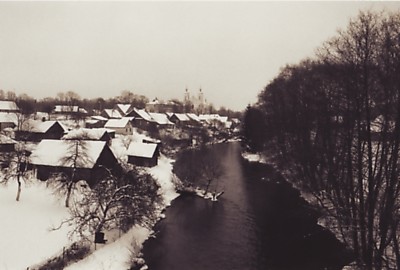
Antalieptė, 1991
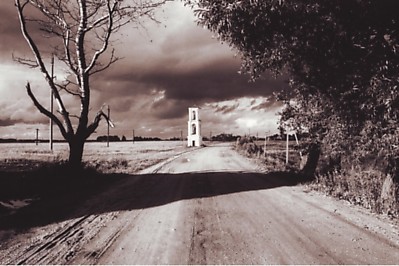
Musninkai, 1989
Vytautas Balčytis regularly travels around Lithuania and uses his lens to capture its small towns. He does this without searching for exceptional objects, without making any attempt to photograph the everyday in some unusual way. Perhaps the most bothering characteristic in Balčytis’s images is tranquillity – tranquillity in the act of photographing, in observing, in the simplicity of the object, and in the way it is presented. Does this tranquillity have to be justified? Does it have to become something else for it to be worth photographing? Why is it that this ordinariness can become significant?
Probably it is not for the purpose of us having a catalogue of Lithuania’s small towns, even though one should not reject the documentary values of this series. Vytautas Balčytis is able to place the viewer in his images and to teach him or her to observe time past - the Soviet era, the pre-war years, the 19th century - in the present. To observe buildings, churches, the everyday in nature’s endless routine. According to the photography critic Agnė Narušytė „in recording the immutable quality of things in historical time Balčytis dissolves it through the ephemerality of the present [...]. It seems that two speeds collide here – the slowly fading past and the fast fading present”.
The British poet Stephen Watts has admired work by Vytautas Balčytis and has written about him in one of his essays: "Balčytis has rarely left Lithuania, as far as I know. Certainly the majority of his work is of Lithuanian cities, Vilnius especially, or its small towns. And yet his work takes on something not limited by space. Certainly he knows where he is working, and that matters. On the other hand his work is not widely known outside Lithuania, or outside small Lithuanian circles. Almost all of his exhibitions have been in Vilnius, or in Šiauliai or Palanga. In one sense his work does not travel. But in another sense it most certainly does. It never remains within the confines of itself, not because it is part of a globalised economy or aesthetics, but rather because it so intimately and painstakingly understands its local truth. It brings us up against the ironies of language : ‘that is all we have to know’ !
That is all we need to know ! That is all we have. To know … And so on.
It is not melancholy that mists or reduces his images. It is not a weasel to suck out light as it might the yolk of an egg, leaving just the white: though white (and greys and the gradations between) is of the essence of his work. It is immersement in and understanding of a social reality, it is that sort of a reduction that then leaves the artist with a residue: the stuff and exacted light of his art.
Perhaps his work is more akin to that of certain contemporary Lithuanian poets, video-artists and composer-musicians than to any mainstream of image-makers."
Balčytis‘ works are displayed in the collections of Lithuanian Museum of Art, Vilnius; Lithuanian National Museum, Vilnius; National Museum, Wrocław; Museum of Modern Art, Łódź; Musée d'Art Moderne de la Ville de Paris.
The exhibition has been organised in cooperation with the Association of Lithuanian Art Photographers.
For further information please contact Daiva Parulskienė, culture@lithuanianembassy.co.uk or call 020 7935 9872
Location: Lithuanian Embassy in London, 84 Gloucester Place, London W1U 6AU
Open Monday – Friday from 10am to 5pm


