


"Lithuania and the Collapse of the USSR" at the Tate Modern and Edinburgh Filmhouse
8 March, 14 March, 2009. Forces of time, memory, change, and the human condition collide in Jonas Mekas’ compelling work Lithuania and the Collapse of the USSR. The work’s title refers to the historical time when the world watched on as Mekas’s home country of Lithuania fought for independence from the stronghold of Soviet rule, and, with a video camera, Mekas recorded the newscasts that played daily from 1989 to 1991 on his television set at home. On 8th March the film will be screened at the Tate Modern, and on 14th March - at the Edinburgh Filmhouse.
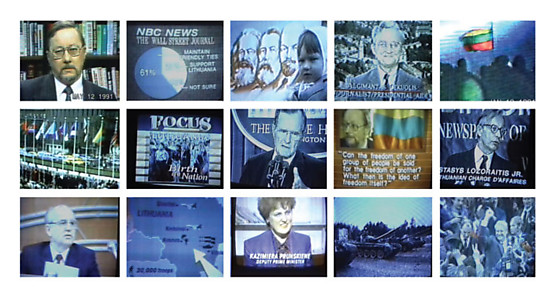
Comprising four chapters with a total running time of 4 hours and 46 minutes, it will be presented in four parts with short breaks for reflection, as a chronological overview of Lithuania’s birth as an independent nation.
"The video is made up of footage that I took with my Sony from the television newscasts during the collapse of the USSR, with the home noises in the background. It’s a capsule of record of what happened and how it happened during that crucial period as recorded by the television newscasters. It can be viewed as a classical Greek drama in which the destinies of nations are changed drastically by the unbending, bordering on irrational will of one single man (Vytautas Landsbergis), one small nation determined to regain its freedom, backed by its fight against the Might & Power, against the Impossible." – Jonas Mekas.
Cast of Characters (in order of initial appearance)
Manohla Dargis, The New York Times: "Much as collagists have done since Braque and Picasso started cutting up daily papers, Mr. Mekas is performing an aesthetic intervention here: he has appropriated found material, in this case news reports shot off his home television, to his own deeply personal ends. The results, though far from visually beautiful (and here the analogy to Braque and Picasso ends), are nevertheless strangely, almost perversely entrancing, largely because the enterprise, which at first seems unwatchable — this is, after all, nearly five hours of jumpy, often blurry newscasts — becomes an increasingly gripping story of revolt, courage and power.[...]
Though it has undeniable force, I’m uncertain if “Lithuania and the Collapse of the USSR” would have pulled me in so strongly if I were not familiar with Mr. Mekas’s work, particularly that most overtly dedicated to his life as a displaced person. He and his brother, the filmmaker Adolfas Mekas, fled their Lithuanian home in 1944, spent time first in a German labor camp and then a displaced-persons camp, eventually sailing up the Hudson River in 1949 on a ship named the General Howze. Jonas Mekas went on to be a major avant-garde filmmaker, give us the Film-Makers’ Cooperative and Anthology Film Archives and become a national treasure. And years later he sat in his home and watched one world collapse, as another began."
In collaboration with the Lithuanian Embassy in the UK and the Ministry of Culture of the Republic of Lithuania.
Tate Modern, Starr Auditorium, Bankside, London SE1 9TG. Tickets: £5 (£4 concessions), you can book the tickets here.
http://www.tate.org.uk/modern/eventseducation/film/17102.htm


