


Lithuania and Collapse of the USSR by Jonas Mekas at Gilmorehill in Glasgow
13 March, 2010. Forces of time, memory, change, and human collide in Jonas Mekas’ compelling work Lithuania and the Collapse of the USSR (2008). The work’s title refers to the historical time when the world watched as Mekas’ home country of Lithuania fought for independence from the stronghold of Soviet rule. Comprised of 4 parts with a total running time of 4 hours and 46 minutes, it will be presented in 4 parts at the Gilmorehill 12 in Glasgow. The film will be introduced by Louis Benassi, curator, artist and filmmaker and Professor David Smith, Head of the Department of Central and East European studies, Glasgow University. The screening will be followed by Q&A.
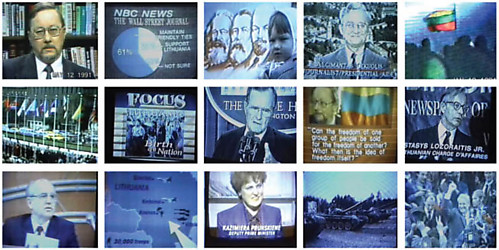
With a video camera, Mekas recorded newscasts that played daily from 1989 to 1991 on his television set at home. Footage includes reports of the Soviet Union’s use of “aggressive actions” that called for Lithuanian back down, freedom demonstrations, interviews and statements made by top politicians, journalists, and analysts that include Lithuanian President Vytautas Landsbergis, Deputy Prime Minister Kazimiera Prunskiene, Soviet Leader Mikhail Gorbachev, Russian President Boris Yeltsin, United States President George H.W. Bush among others, as well as moving portraits of the Lithuanian people who were directly affected by the conflict. Mekas’ account, reported by news outlets in the United States, also reveals the shaping and shifting of political, economic, and social relations between the Eastern Europe and the West at the time.
“The video is made up of footage that I took with my Sony from the television newscasts during the collapse of the USSR, with the home noises in the background. It’s a capsule of record of what happened and how it happened during that crucial period as recorded by the television newscasters. It can be viewed as a classic Greek drama in which the destinies of nations are changed drastically by the unbending, bordering on irrational will of one single man (Vytautas Landsbergis), one small nation determined to regain its freedom, backed by its fight against the Might & Power, against the Impossible.” Jonas Mekas
"Much as collagists have done since Braque and Picasso started cutting up daily papers, Mr. Mekas is performing an aesthetic intervention here: he has appropriated found material, in this case news reports shot off his home television, to his own deeply personal ends. The results, though far from visually beautiful (and here the analogy to Braque and Picasso ends), are nevertheless strangely, almost perversely entrancing, largely because the enterprise, which at first seems unwatchable — this is, after all, nearly five hours of jumpy, often blurry newscasts — becomes an increasingly gripping story of revolt, courage and power." Manohla Dargis, The New York Times
Full Production Credits: Director, Producer, Cinematographer, Art Designer - Jonas Mekas, Editor - Elle Burchill
Anthology Film Archives - Domestic Theatrical Distributor
Cast of Characters (in order of initial appearance)
12:00 Part 1 - 75 min
1:30 pm Part 2 - 69 min
3:00 pm Part 3 - 75 min
4:30 pm Part 4 - 67 min
Louis Benassi is curator, artist and filmmaker. He has curated and programmed experimental film for numerous international film festivals, including Jonas Mekas’ retrospective at Edinburgh International Film Festival in 2002. In 2001 he began Spool-Pool, a transient forum for film and the spoken word. www.spoolpool.com
Screening organized in collaboration with CRCEES, Centre for Russian, Central and East European studies, Glasgow University, the Lithuanian Embassy in the UK and the Ministry of Culture of the Republic of Lithuania.
13 March, 12:00, Gilmorehill G12, 9 University Avenue, University Of Glasgow, G12 8QQ, Scotland, UK
tel: +44 (0)141 330 5522
boxoffice@gilmorehillg12.co.uk
Admission free with ticket from box office.
Image © Jonas Mekas


