Liberty, Power and Identity in the Grand Duchy of Lithuania: The Legacies and Lessons of the Commonwealth
21 October, 2009. An international conference hosted by The Centre for the Study of Central Europe at UCL-SSEES, organized in partnership with The Lithuanian Historical Institute, Vilnius, and The Embassy of the Republic of Lithuania, London, will examine the questions of liberty, power and identity in the history and historical legacy of the Grand Duchy of Lithuania (GDL).
The GDL was inhabited by a highly diverse population, from which descended the modern Lithuanian, Belarusian, Ukrainian, Polish, Jewish, Latvian and other nations. Following its vast expansion in the later middle ages, when its Gediminid dynasty also came to rule the neighbouring Polish kingdom and, more briefly, the thrones of Bohemia and Hungary as well, the GDL entered a parliamentary union with Poland to form the Respublica or 'Commonwealth of the Two Nations' in 1569. This was an extraordinary constitutional experiment in a mixed, monarchical, aristocratic and democratic form of government, aiming at the preservation of political liberty, and at reaching consensus between different regional and confessional interests. It drew deeply on the classical republican tradition. It is worth emphasizing, that for well over a century, before this system fell into international disrepute in the early eighteenth century, intellectual, cultural, confessional and economic interaction between Western Europe and the GDL/Commonwealth was very much in both directions.
The axis of power and liberty has always been salient for the political, social and cultural tensions in Central and Eastern Europe, not least in the twentieth century. It is intrinsically linked with the politics of 'identity' - whether national, religious, social, gender or sexual. It is connected with the questions of the extent of toleration extended to minorities, and to the achievement of political and cultural consensus. As Lithuania celebrates her millennium in 2009, it is a timely endeavor to revisit her foundational experiences as the GDL, and the ways in which its historical legacy has contributed to the shaping of the modern Lithuanian nation, as well as to other nations.
The conference invites us critically to address questions of political thought on liberty and institutions of power, material and intellectual exchange between 'East' and 'West', and the politics and governance of multicultural and multi-religious societies, as they developed in the GDL/Commonwealth and were subsequently remembered and imagined.
Organizers
Richard Butterwick (UCL-SSEES): r.butterwick@ssees.ucl.ac.uk
Darius Staliūnas (Lithuanian Historical Institute, Vilnius): staliun@takas.lt
Eglė Rindzevičiūtė (De Montfort University, Leicester): erindzeviciute@dmu.ac.uk
Daiva Parulskienė (Embassy of the Republic of Lithuania, London): culture@lithuanianembassy.co.uk
Venue: UCL Main Quad, South Wing, Council Room
Programme of the conference: http://www.ssees.ac.uk/gdl.htm
Supporters
The Lithuanian Historical Institute
The Embassy of the Republic of Lithuania in the UK
The Ministry of Science and Education of the Republic of Lithuania
The Ministry of Culture of the Republic of Lithuania
The Centre for the Study of Central Europe at UCL-SSEES
Polish Cultural Institute
Anglo-Belarusian Society
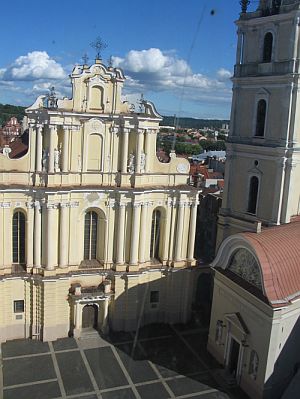
Below: the principal courtyard of Vilnius University with the Church of Saints John the Baptist and John the Evangelist