


"Journey through Lithuania" at the Lithuanian Embassy
4 May, 2010. The new documentary by Vaidotas Digimas and David Ellis Kelionė per Lietuvą (Journey through Lithuania), will be screened at the Lithuanian Embassy on 4 May, at 7 pm. The film will be presented by the artist, writer, curator and cultural historian David Ellis, the screening will be followed by a discussion moderated by Paulina Pukytė. To register for the event please send a message to rvpifas@yahoo.com.
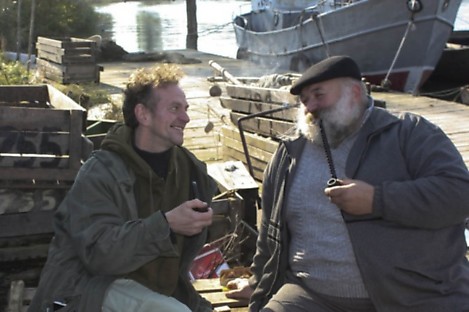
Film: To mark the 20th anniversary of Lithuania's independence the British Artist-Writer-Curator & Cultural historian David Ellis embarked on a journey through Lithuania to meet people and gauge the tempo and success of the transition. The making of the film had several agendas: it's about memory, about migration, and about returning home perhaps, and about the occupation of not just the country but the psyche, Ellis said. In the film, he discusses politics, history and culture with leading Lithuanian figures. "I see Lithuania in the images, which I would like to record, and the British insights should reveal the country's specific qualities in the best way," said the film's director Vaidotas Digimas. Film producer Živilė Gallego said the film was shot in 10 days in several Lithuanian cities.
Discussion: After the screening you are invited to analyse and discuss the film in terms of its attitude to its subject matter (Lithuania): colonial or post-colonial representation? Also: who is the target audience and what is the goal of this film and whether the goal is achieved.
Reading: “In that [colonial] era, even ethnographic writing, for all its intentions of neutrality and objectivity was generally uni-ocular: the gaze went all one way. We [Western culture] represented them [non-Western culture] in our ways of representation. What resulted was often either Western discourse applied blindly outside its sphere of relevance, or, in perhaps the most sensitive cases, what Clifford Geertz has called “haunted reflections on Otherness”. James Clifford has written of the need for ethnographic discourse to become a dialog in which the identities of both observer and observed are in question – that is, in which each party is open to influence, to being changed inwardly, by the other – as opposed to “discourses that portray the cultural realities of other peoples without placing their own reality in jeopardy.” [...] One would think that a post-colonial attitude must acknowledge different theories of knowledge, including some that imply the falsity of one’s own inherited assumptions. One is bound, in other words, to betray one’s own specific ethnic inheritance in the attempt to open oneself to the reality of others.” From Thomas McEvilley Art and Otherness: Crisis in Cultural Identity, Kingston, NY: Documentext/McPherson & Company, 1992, pp. 96, 99.
David Ellis is based in London. A rogue enthusiast, advocate of radical affability, obstinate otherness and a performer, writer, curator. He was co-founder of Puzzleclub with BBC writer Hattie Naylor (1994-1997), a platform for convergent art. Since 1993 Ellis has travelled in Lithuania acting as an advocate for filmmakers, writers, etc., as part of a make-shift anthropological inquiry into its lesser-known history. Previous collaborators have included Iain Sinclair, Jonas Mekas, Ben Northover, Louis Bennasi, Andrea Dworkin, Ken Hollings, Stephen Barber, Nitin Chandra Ganatra, Alaknanda Samartha, Simon Tyszko and Paul Burwell. He has acted as facilitator for Index-on-Censorship, the Royal Institute of British Architects and The Sound Archives of the British Library. He is a contributor to Vertigo the quarterly magazine for Independent Film and Video and produced Silent Key for BBC Radio 3 in 2001. He recently worked on the new Ridley Scott film Robin Hood (2010) as Dancer / Background Artist.
Production credits of the film:
Year: 2010
Country: Lithuania
Runtime: 75 min.
Direction / Cinematography: Vaidotas Digimas
Journalist / Artist: David Ellis
Company: Fralita films
Dialogs: Lithuanian
Subtitles: English
4 May, 7pm. Lithuanian Embassy in London, 84 Gloucester Place, W1U 6AU London, Metro: Baker street. Donations for Šviesa Santara are welcome.


