


Expanding the Lithuanian photography collection at the Victoria and Albert
On display at the traditional annual photography exhibition at the Victoria and Albert Museum, the most famous repository of applied art in the world, are eight works by the Lithuanian photographers Aleksandras Macijauskas and Indrė Šerpytytė. The Lithuanian section in the V&A’s photography collection was considerably expanded during 2009-2010.
The curators of the museum have acquired the cycle MGB-NKVS-KGB by the Lithuania born photographer Indrė Šerpytytė. Her most recent work is related to the armed anti-Soviet resistance in Lithuania in 1944-1953, the so-called war after the war. Indrė Šerpytytė invokes the memory of these historical events by visiting actual sites and taking photographs of the buildings previously used by the NKVD-NKGB-MVD-MGB Soviet forces struggling against the partisan movement. Later the artist ‘translates’ them into photographic and sculpted images. According to Indrė, the buildings become dead buildings, completely sealed, containing the memories inside them.
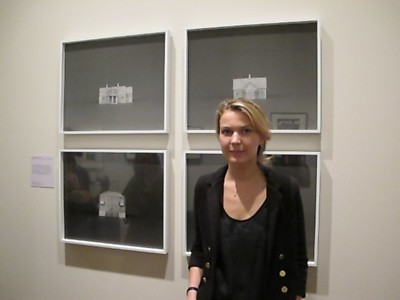
Indrė Šerpytytė and her work, V&A
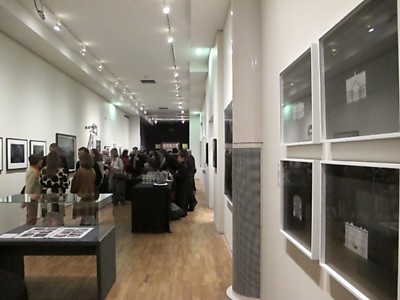
Photography Gallery at the V&A
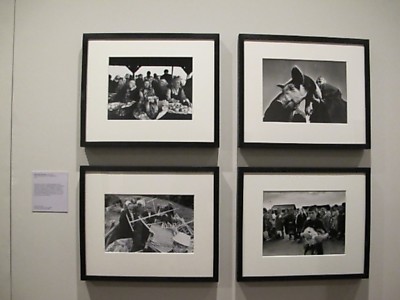
Aleksandras Macijauskas' 'Village Markets' at the V&A Gallery
Apart from works by the present generation, the museum has also acquired a collection of important works by photo-artists belonging to the classical school of Lithuanian photography. These photographs were presented to the V&A by Kastytis Baublys, the son of the architect and civil engineer Rostis Baublys.
Rostis Baublys early on in his life developed an interest in the visual arts and acquired an extensive collection of works by Lithuanian artists prior to leaving Lithuania in July 1944 just before the second Soviet occupation of Lithuania. He came to England in 1949 and joined the Ministry of Works in 1951, working as an architectural draftsman in the Ministry of Works and its successor ministries until his retirement in 1974.
He thought it important to maintain links, particularly cultural links, with Lithuanians living in Lithuania, in order to decrease their feeling of isolation from the West. He thought it highly desirable for the public in the United Kingdom to be aware of Lithuania’s existence as a country with its distinctive linguistic, historical and cultural identity. He founded the Lithuanian Arts Club to assist with this work.
Rostis Baublys began a correspondence both with individual Lithuanian photographers and with the Lithuanian Photography Society, and he acted as a link between Lithuanian photographers and the editors of the Photography Year Book with a view to photographs taken by Lithuanian photographers being included in the Year Book. In 1973, he was instrumental in arranging an exhibition of Lithuanian photographs at the Photographers’ Gallery in London. The photographers represented were Aleksandras Macijauskas, Algirdas Pilvelis, Romualdas Rakauskas, and Antanas Sutkus.
It was this group of photographs for that exhibition, with the mediation of the Lithuanian cultural attaché and with the agreement of the Lithuanian Photography Society, that came to be included in the V&A’s collection. The museum acquired 39 works by the photo-artists Aleksandras Macijauskas, Romualdas Rakauskas, Antanas Sutkus, Algirdas Pilvelis, Jonas Kalvelis, and Vitalijus Butyrinas.
Four photographs from this collection by Aleksandras Macijauskas - from the series Village Markets - are on display in the annual exhibition.
The V&A began acquiring photographs in 1852 and its collection is now is one of the largest and most important in the world. It holds over 500,000 images, by both classic and contemporary photographers, and illustrates a wide range of processes, techniques and subject matter. The Photography Gallery focuses on the history of photography, with an annual display of around 40 outstanding photographs from the V&A’s collection (Photography gallery, Room 38a). The current annual display will be open until mid-May 2011.
Victoria & Albert Museum, Cromwell Road, London SW7 2RL. Photography Gallery (38a). Free entrance. Open every day from 10am until 5.45pm.


