


Discovering Čiurlionis - Piano Marathon
19 November, 2011. As 2011 marks the centenary of the death of Lithuanian visionary composer and painter Mikalojus Konstantinas Čiurlionis (1875-1911), London based pianists come together to celebrate his piano music. Martyna Jatkauskaitė, Morta Grigaliūnaitė, Jelena Makarova, Aleksandra Myslek, Vita Panamariovaitė, Kamilė Radzvilaitė, Maria Verbaitė and Rimantas Vingras will perform Čiurlionis' piano music from various periods of the composer's life.
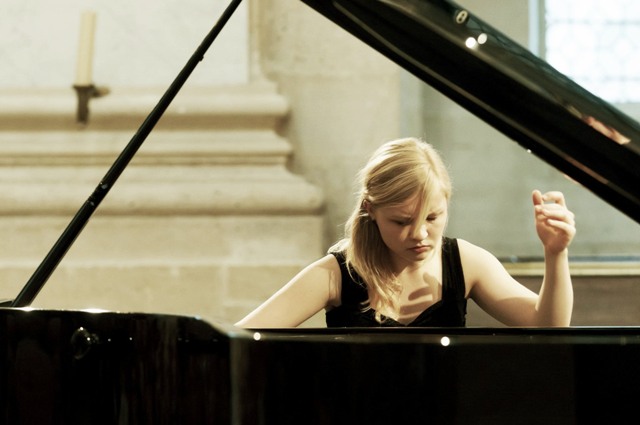
Pianist Morta Grigaliūnaitė
Over a mere decade-long career, Čiurlionis composed nearly four hundred musical compositions, including two large-scale symphonic poems, an overture, two piano sonatas, a string quartet, a cantata for choir and orchestra and a large volume of music for piano. During those same brief years he also created approximately four hundred paintings and etchings, as well as several literary works and poems, while still finding time to experiment with art photography. Notes from his study years at the Warsaw Institute of Music show his interest in geology and history, chemistry and geometry, physics and astronomy, astrology and ancient mythology, dead and modern languages, philosophical ideas of antiquity and modernity, eastern and western religions.
On the other hand, his active involvement in the Lithuanian national movement and his idealist self-sacrifice for the sake of artistic ideals show him as a typical artist in the Romantic mould. During his short life, Čiurlionis managed to be at the heart of the creation of the Lithuanian Artists Union. He actively organized and participated in the first three exhibitions of Lithuanian artists, organized and conducted Lithuanian choirs in Warsaw, Vilnius, and St. Petersburg, and was the first Lithuanian professional composer to take an interest in Lithuanian folk songs, collecting and publishing them.
At the junction of the 19th and the 20th centuries Čiurlionis embodied the aspirations of the national revival movement and linked them with the latest tendencies in European art of the time. He followed the German Symbolists in his paintings, exploring synaesthetic ideas, fashionable at the time, and delved into chromatic and harmonic possibilities of the tonal major-minor system in his music compositions. In these aspirations Čiurlionis stands as the representative European artist at the turn of the 20th century.
Finally, his mature paintings, based on intricate musical compositional techniques, and piano compositions in which tonal writing is blended with proto-serial techniques and the constructive use of short rhythmic, melodic and harmonic patterns, stand as examples of unprecedented visual and aural experiences unique in the history of European art.
To learn more about Čiurlionis please visit www.ciurlionis.eu
19 November 7.00 pm, St Giles’ Cripplegate Church, Fore Street, Barbican, Cripplegate, London, EC2Y 8DA. Tickets: £10 at the door.


