Czesław Miłosz: the Centenary Celebrations
2011 is the centenary of the birth of Czeslaw Milosz, one of the world’s greatest poets and writers. Czeslaw Milosz was born on the 30th of June 1911 in the village of Šeteiniai (Szetejnie) in Lithuania and was of mixed Lithuanian-Polish ancestry. Polish was his first language but he learned several more languages, as war and exile drove him from Lithuania to Poland to France and the USA. He died in 2004 aged 93 in Krakow, Poland. Miłosz bore witness to the turbulence of the 20th century and left behind a brilliant and abundant literary legacy.
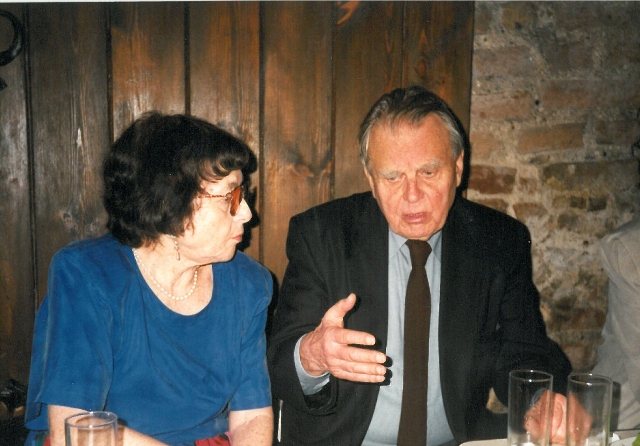
Czesław Miłosz during one of his visits to Lithuania with Prof. Irena Veisaitė
Czesław Miłosz won the Nobel Prize for Literature in 1980 and was showered with honorary doctorates, prizes and praise. He was feted by admirers like Seamus Heaney, Derek Walcott, Robert Hass, Joseph Brodsky and Tomas Venclova.
Czesław Miłosz defied genres: he wrote poetry, novels and essays and translated widely, including American poetry and the Bible. His novel ‘The Seizure Of Power’, set in the early days of Polish communism, is a modern classic. His most celebrated non-fiction work is ‘The Captive Mind’, written in exile in Paris and exploring how intellectuals behave under repressive regimes. It was compared with Koestler’s ‘Darkness at Noon’ and Orwell’s ‘Nineteen Eighty-Four’.
Czesław Miłosz published 17 collections of world-class poetry. Personal and political, serious and sensuous, pastoral and religious, visual and analytical, the poems cover seven decades, from his student days in Vilnius, through to Paris in the 1930’s, then Warsaw under Nazi Occupation and the Communist regime; to his 1950’s Paris exile up to his near-4 decades in Washington and Berkeley, first as diplomat, then as professor. Finally, there are the poems written after the fall of Communism, when he returned to live in Krakow.
The spaces of Czesław Miłosz that in his poetry serve as the most important guidelines in search of reality and meaning include Lithuania, Poland, Central and Eastern European region, France, and the United States of America. Those spaces are Miłosz’s favorite cities, first of all, Vilnius, Krakow and Paris, whereto his imagination and memory kept coming back; those spaces also include different types of natural landscapes of the Šeteniai (Szetejnie) and Nevėžis (Niewiaża) coasts, Krasnogruda and the lakes of the Seinai (Sejny) region, southern France and the Mediterranean Sea Basin, the scenery of the Pacific and the Gulf of California. These sites are not only the geography of Miłosz's life, but also his creative work’s metageography, the topic of his identity. Localized experience, loyalty to tradition, inter-cultural identity and reflection of the universal human condition uniquely complement each other in his work.
Time dimensions that Miłosz's work unlocked and always paid close attention to are equally multiple and complex. From the catastrophe of youth, his texts present a tragic and controversial historical experience of the 20th century Europe; they also maintain a strong connection to the memory of different times in the past. Miłosz's works are characterized by emphatic embodiment into the human situations of the pre-Christian Europe, the 16th century, the beginning of the 19th or the middle of the 20th century. His work is open to the inevitable and vital change of the human world, but it also testifies to the endurance of his profound experience. In his texts, the Grand Duchy of Lithuania carried on its "afterlife”, while Miłosz continued to identify himself with its historical concept of citizenship in the 20th century. On the other hand, his ability to move forward in time would lead him to the contemplation of the future of European culture, while emphasizing the importance of the eschatological imagination of contemporary literature.
One of the central events of the Miłosz centenery celebrations in Lithuania will be international conference Times and Places of Czeslaw Miłosz, organized by the Institute of Lithuanian Literature and Folklore and Vilnius University and sponsored by the Science Council of Lithuania and the The Ministry of Culture and National Heritage of Poland („Miłosz 2011 – Promesa”). The conference will discuss the ways of the topography, time perception, and historical imagination in Miłosz's work relate to the problems of personal identity, moral choices, intellectual and political standpoints.
The conference is taking place on June 27 – 28 in Vilnius, and after the conference, the cultural events of centennial celebration programme “The Route of Miłosz” will continue in Kaunas, Kėdainiai, Šeteniai, and Krasnogruda (Poland) on June 29-July 1. Conference participants will be invited to take part in these events as well and to visit the most important places connected to Miłosz and his family’s history.
Miłosz Centenary publication by the Vytautas Magnus University
Highlights of the Miłosz centenary in London will include:
JUNE ‘Poems On The Underground’, London
AUGUST ‘Stephen Fry Reads Czesław Miłosz' – the Audiobook
AUGUST Miłosz Day - Edinburgh International Book Festival
OCTOBER ‘The Mind Of A Great Poet’, British Library, London
NOVEMBER Miłosz International Symposium, University College London
All events are part of Miłosz Year 2011: